
Mont Blanc : The Mountain That Keeps Its Own Weather
18 December 2025
9 Minutes
Mont Blanc introduced itself to me as a sign on a roundabout.
I came through Chamonix after dark — three triangular peaks outlined in rope light and filled with red bulbs, the name spelled out beneath in blue and white. The mountain itself stood somewhere above in the darkness, invisible, entirely indifferent to its own advertisement. I photographed the sign from road level, slightly blurred, and kept the frame precisely because of its imperfection. It seemed important to be honest about how these journeys actually begin: not with revelation, but with signage.

The mountain as advertisement — Chamonix, after dark
The night ended on the Italian side of the massif, where the same mountain wears a different name — Monte Bianco — in a room made almost entirely of wood, somewhere in or near Courmayeur: sloped ceiling, heavy beams, a pool of warm light held around a white bed while everything else fell away into darkness. I photographed it before sleeping, less as a record of lodging than as a note on scale. A small warm enclosure at the foot of something that has no opinion about warmth.

A small warm enclosure at the foot of the massif — near Courmayeur, night
At half past seven the next morning I stepped out and understood the arrangement of things here. The village below was still in blue shadow — stone chalets, timber balconies, a rail fence, one house with its windows warmly lit. Above it, already burning, the wall. First light had reached the upper snowfields and the granite spires while everything human waited its turn. Two temperatures in one frame: the gold that belongs to the mountain, the blue that belongs to the village.
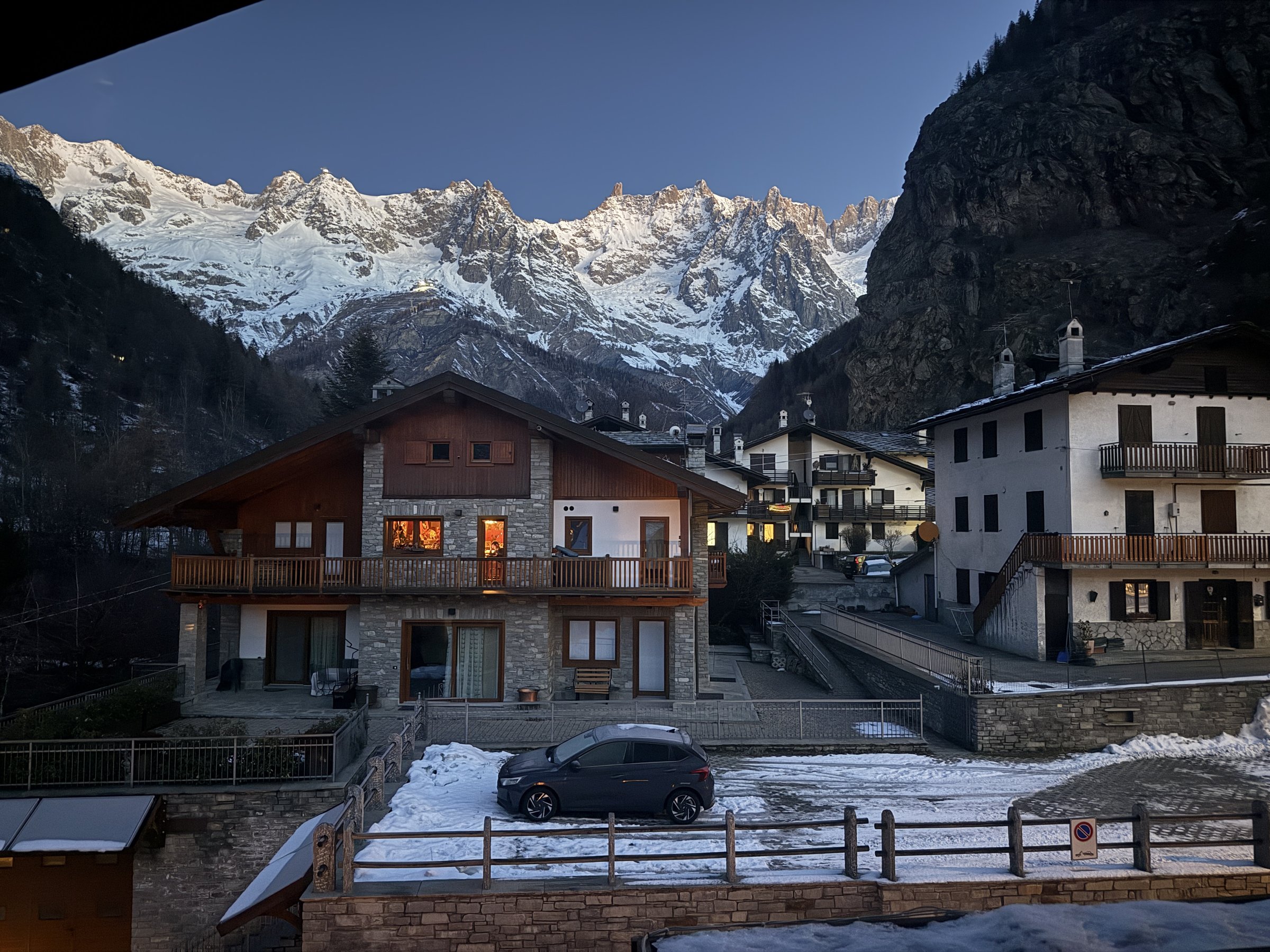
First light on the wall, blue shadow below — near Courmayeur, 07:32
I moved through the village slowly. Whichever way a road points in this valley, it points at the massif — wet tarmac running between a stone chalet with carved wooden balconies and the roadside snowbanks, straight toward the sunlit wall. A few minutes further on, near the cable-car base, the valley floor makes the arrangement explicit: a snow-covered lot, a concrete avalanche gallery, larch slopes gone rusty brown for the winter, and above all of it a hanging glacier spilling its icefall into shadow while the summit dome catches the morning light. The geography composes the picture before you arrive. You accept the leading line you are given.
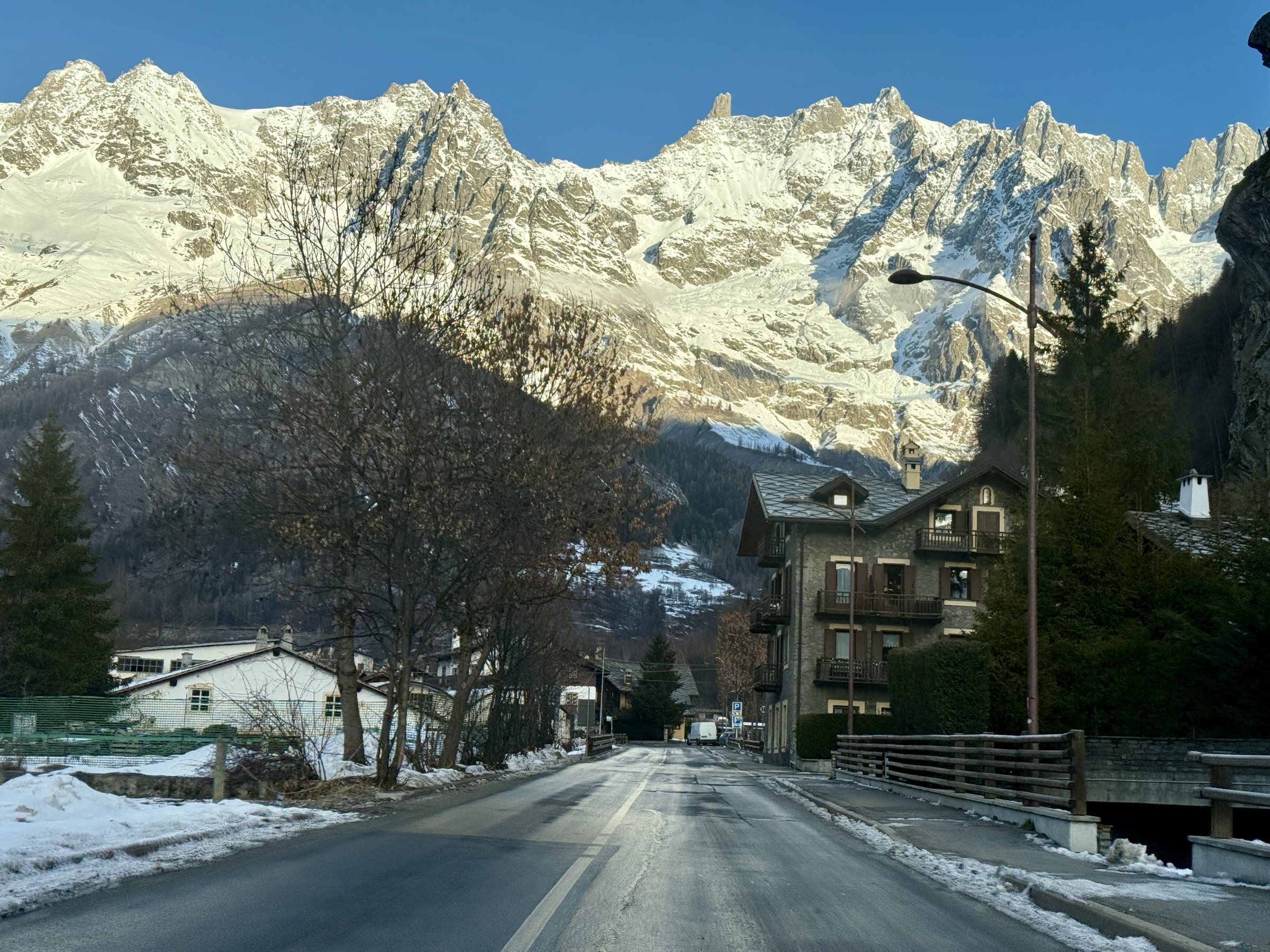
Every road in this valley points at the wall — near Courmayeur
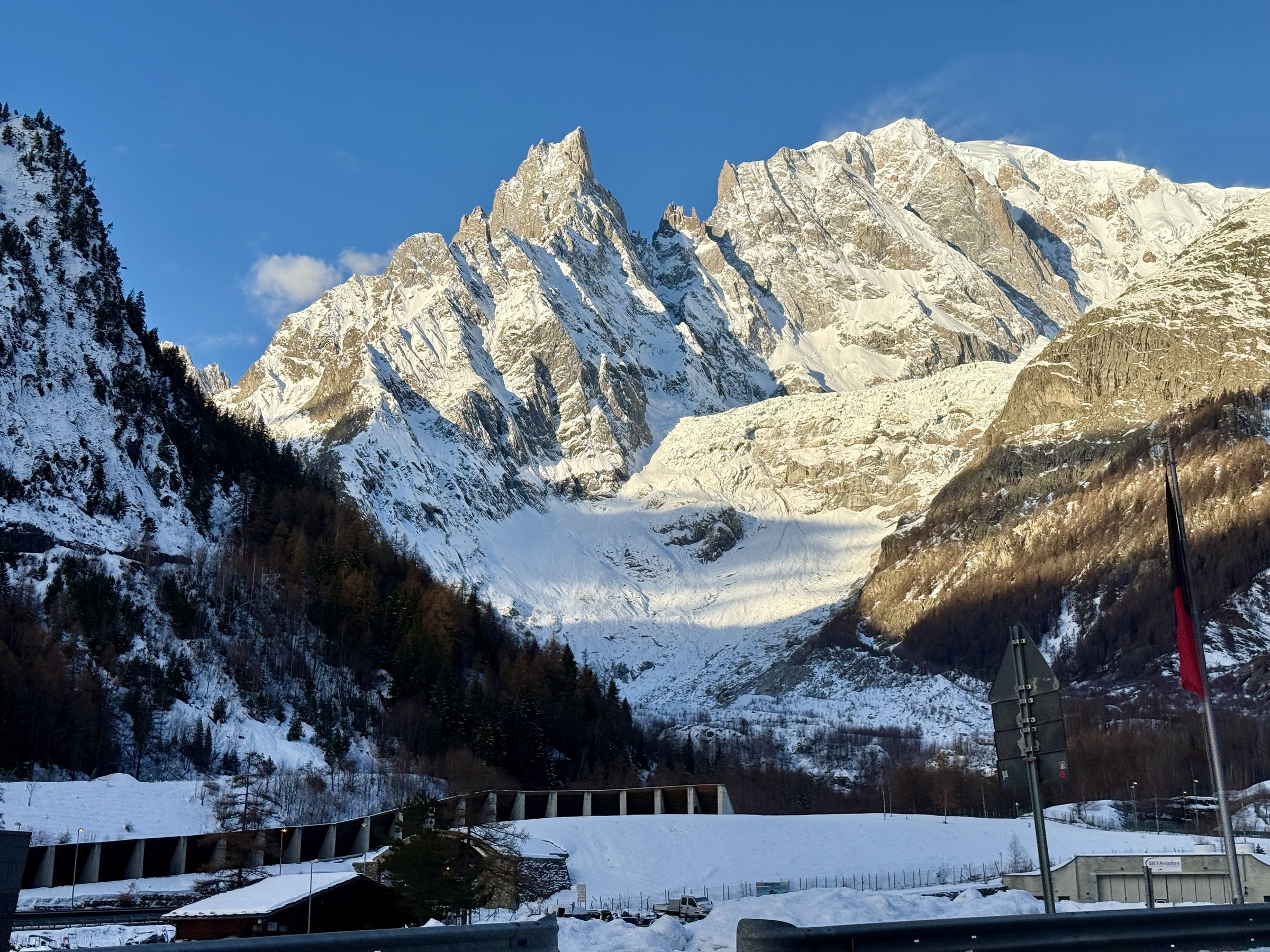
The valley floor makes the arrangement explicit — near Courmayeur
At the base of the cable-way — the Skyway Monte Bianco — I found the first photograph I actually cared about. Two figures stood at the glass balustrade beneath the great arc of the steel canopy, backs to me, looking down the snow-filled valley. They stood the way people stand before things too large to comment on — still, slightly apart, hands at their sides, the polished floor holding their faint doubles. I let the colour go; the frame wanted black and white.
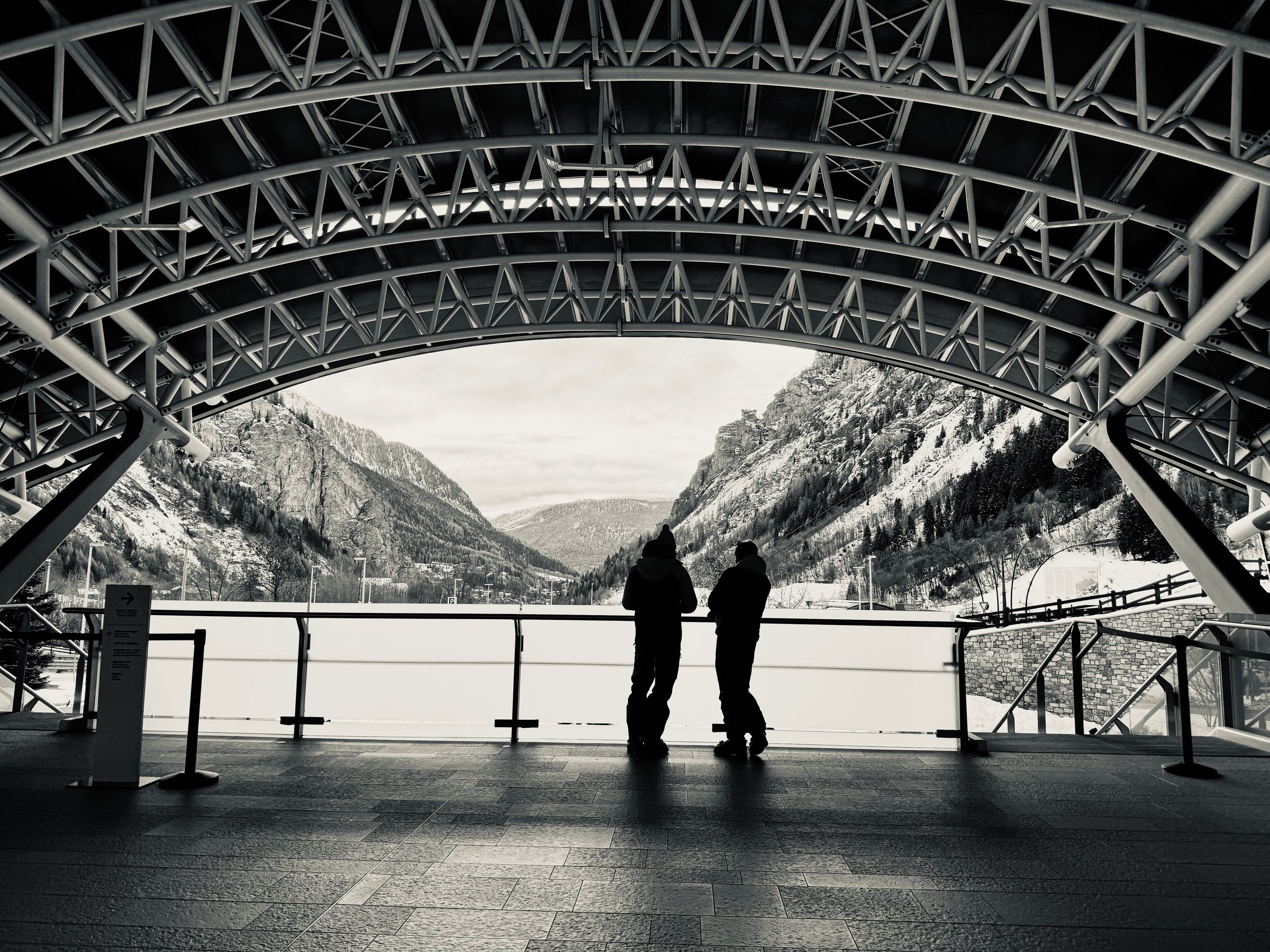
Standing before something too large to comment on — Skyway Monte Bianco
The cabin rotates as it climbs, which means the view is assigned to you and then taken away, over and over. Through the glass, the mid station appeared on its snowy shoulder — a round pavilion with flags on a mast above the terrace, the massif behind it half-erased by moving cloud. I photographed through the window, reflections and all. The honest frame includes the glass.
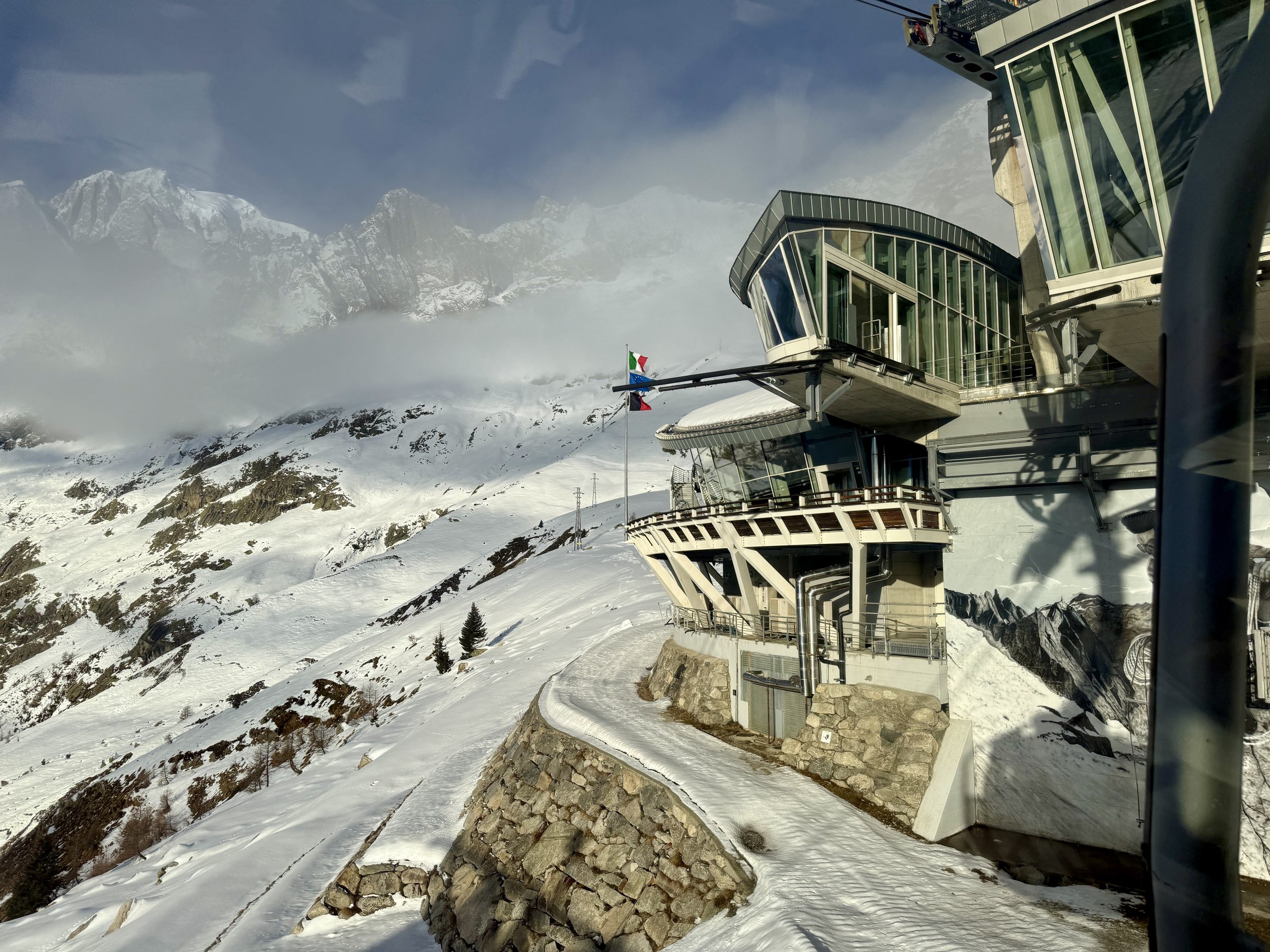
The honest frame includes the glass — Skyway Monte Bianco, mid station
And then, somewhere above the pavilion, the valley was gone.
Below lay cloud — a single unbroken sea of it, filling the valley from wall to wall, with only the cables and a lattice pylon on a wind-scoured ridge to insist that anything mechanical had ever come this way. Through one gap, very far down, a scatter of rooftops. Above the cloud line the world simplified itself into rock, snow, and light, and my photographs simplified with it. Row after row of summits receded toward a bright horizon like restatements of the same thought.
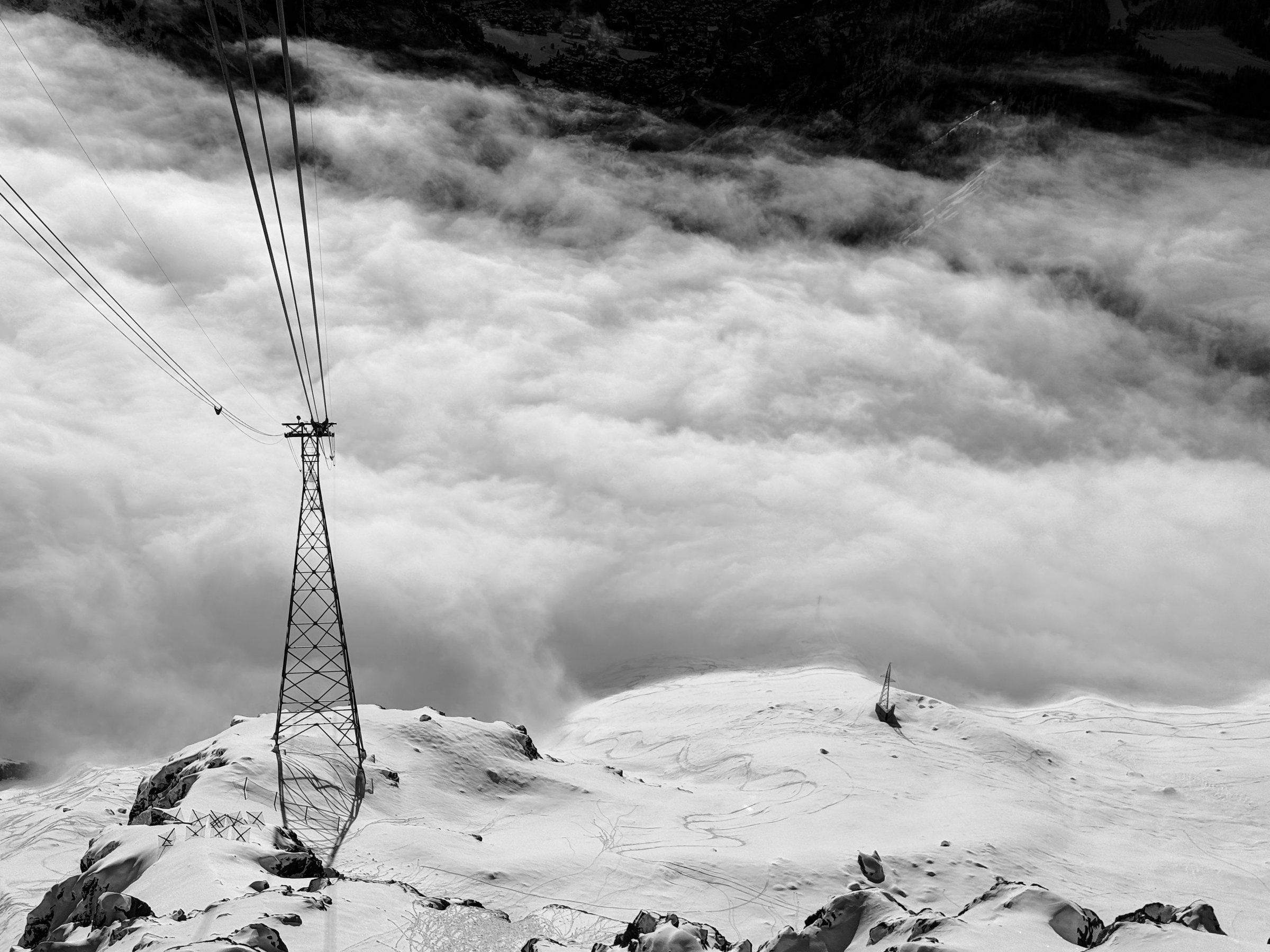
The valley, gone — above Courmayeur
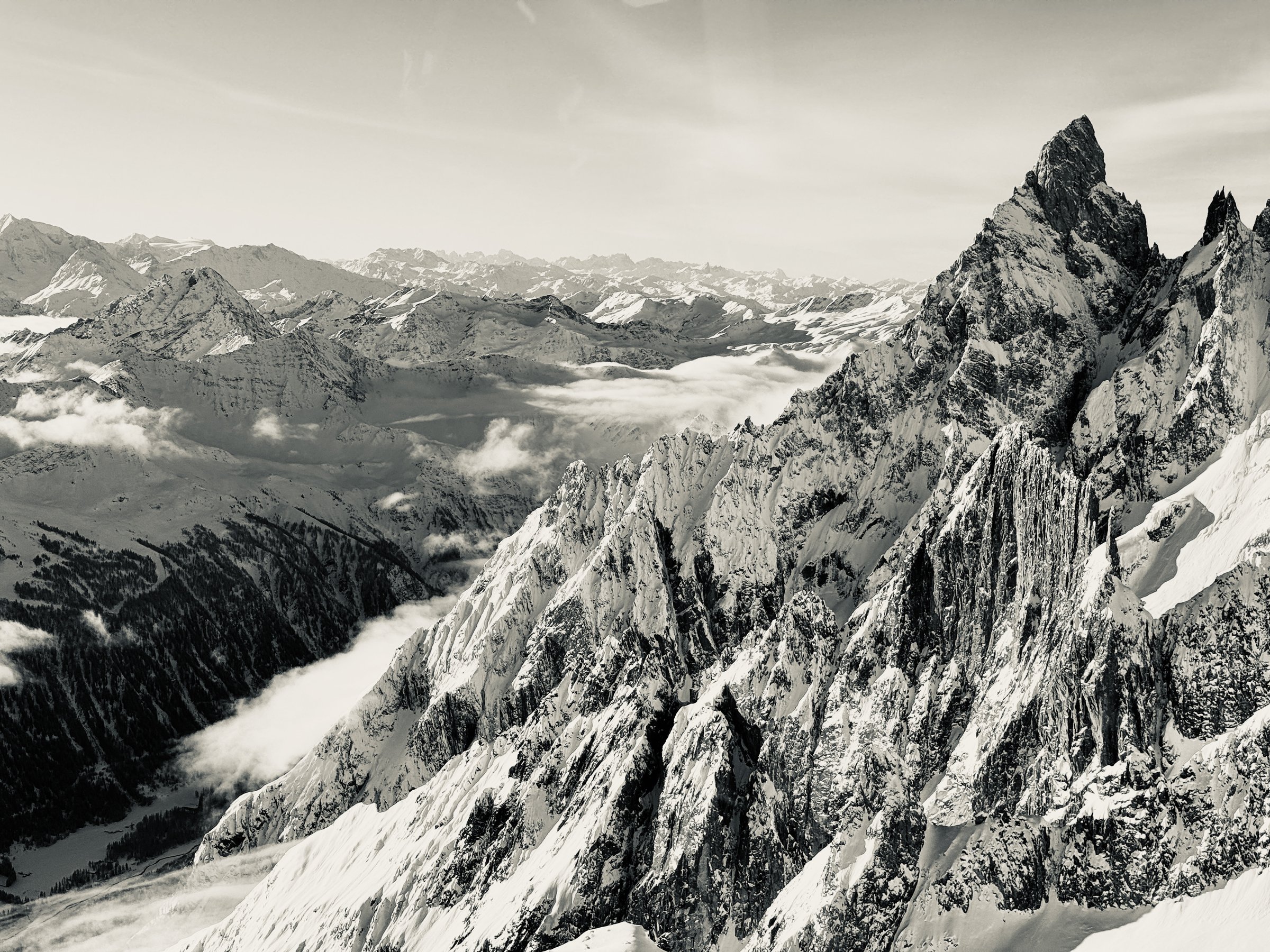
Summits like restatements of the same thought — Mont Blanc massif
At the top station the cabin docked beneath a large painted 3, ice crusted on the antennas, an icicle hanging from the roof edge. Visitors in bright jackets crowded the viewing windows inside, and the haul cables ran out of the station toward brilliantly sunlit snow slopes and a sharp rocky peak in the distance.
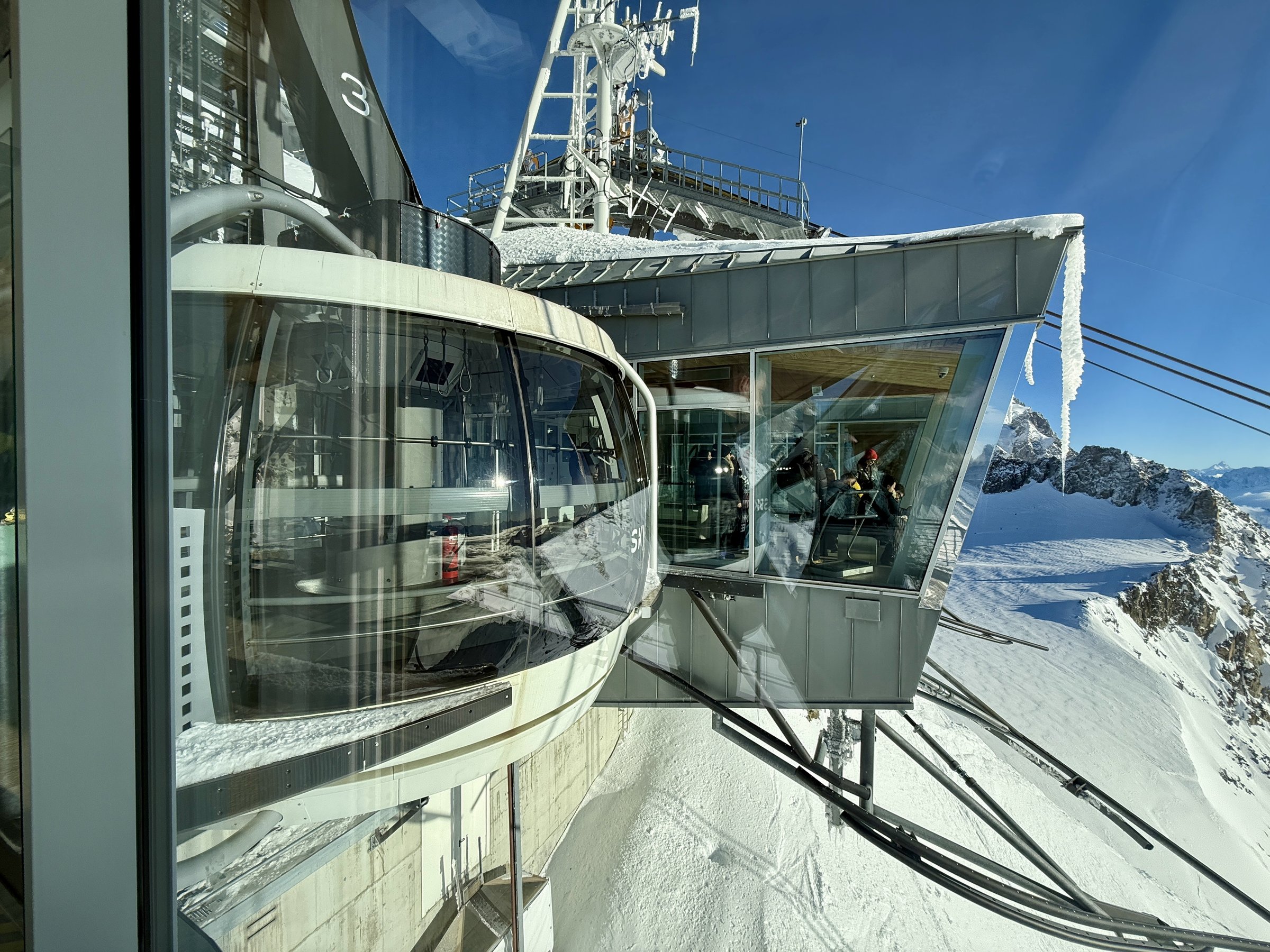
Ice on the antennas, a cabin at rest — Skyway Monte Bianco
Inside, I did something I rarely allow myself: I photographed my own cameras, resting on a table in front of the panoramic glass, dark silhouettes against the blaze of snow and cloud beyond. It is a self-indulgent frame and I kept it anyway, because it says something true — that up here the instruments of looking are humbled into stillness like everything else. The window was doing the work. Everyone in that room was just standing near it.
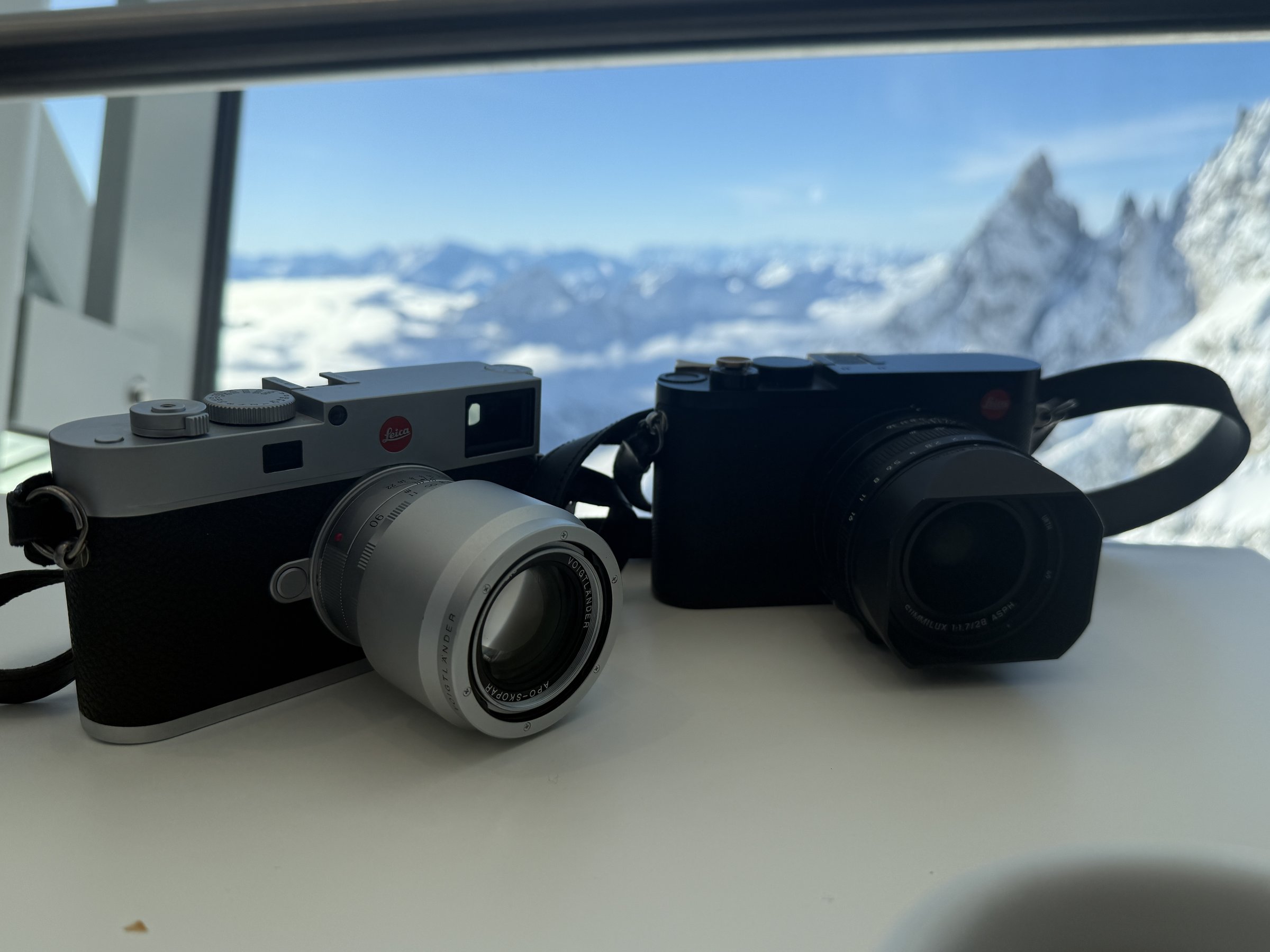
The instruments of looking, humbled into stillness — inside the Skyway station
From the terrace, the essential images offered themselves with almost unfair generosity. Directly below, a stone refuge sat pinned to a snowy saddle between a serrated black ridge and the ocean of cloud, tiny figures on its staircase, a sign on the facade promising, improbably, a bar and a restaurant. Beyond it, on the glacier snowfield, a camp: tents sunk into dug pits like craters, a single-file line of climbers crossing the churned snow, their shadows long, the surface webbed with tracks until it read like a map of every decision made on it that morning.
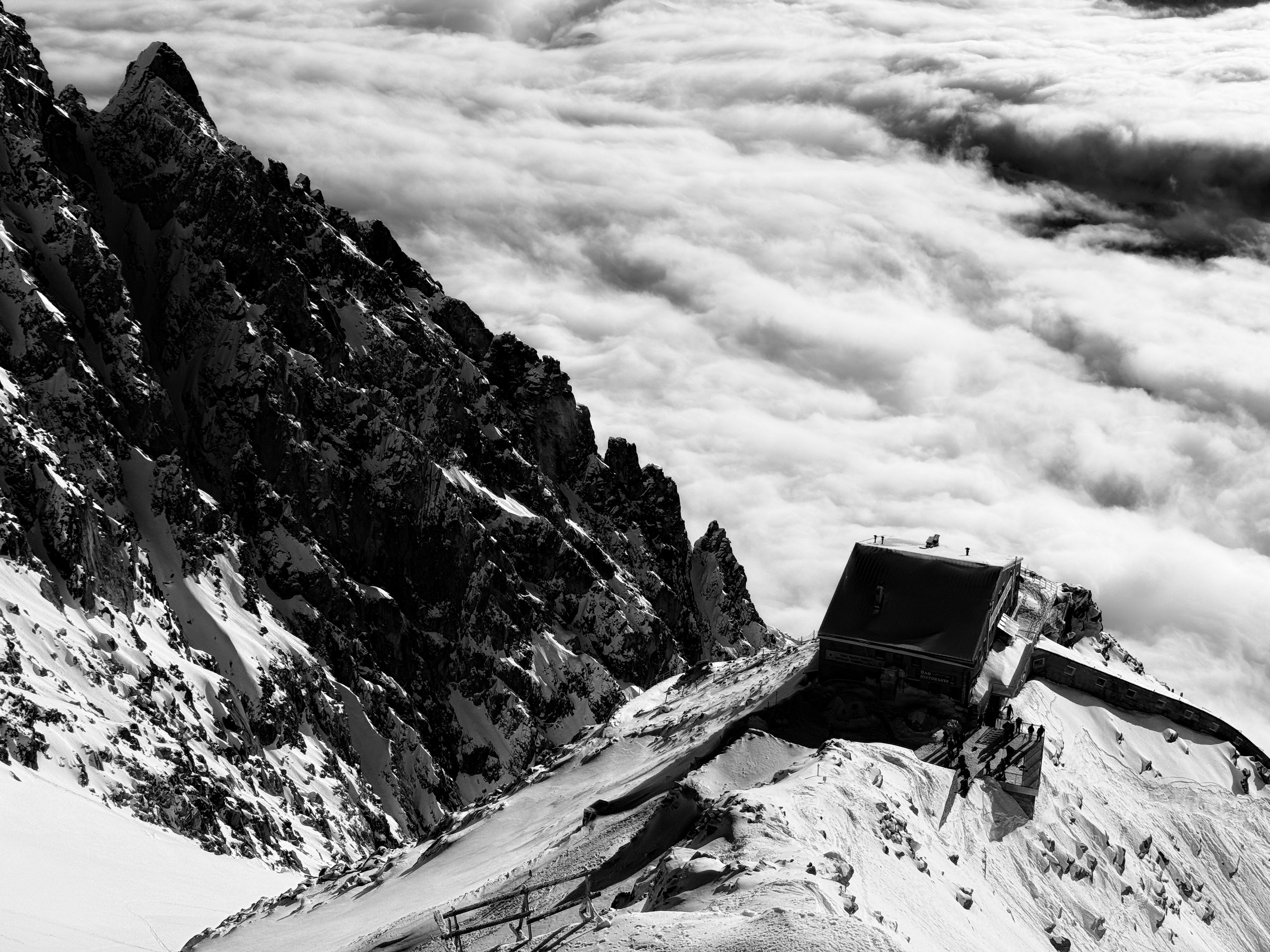
Pinned between rock and an ocean of cloud — below Punta Helbronner
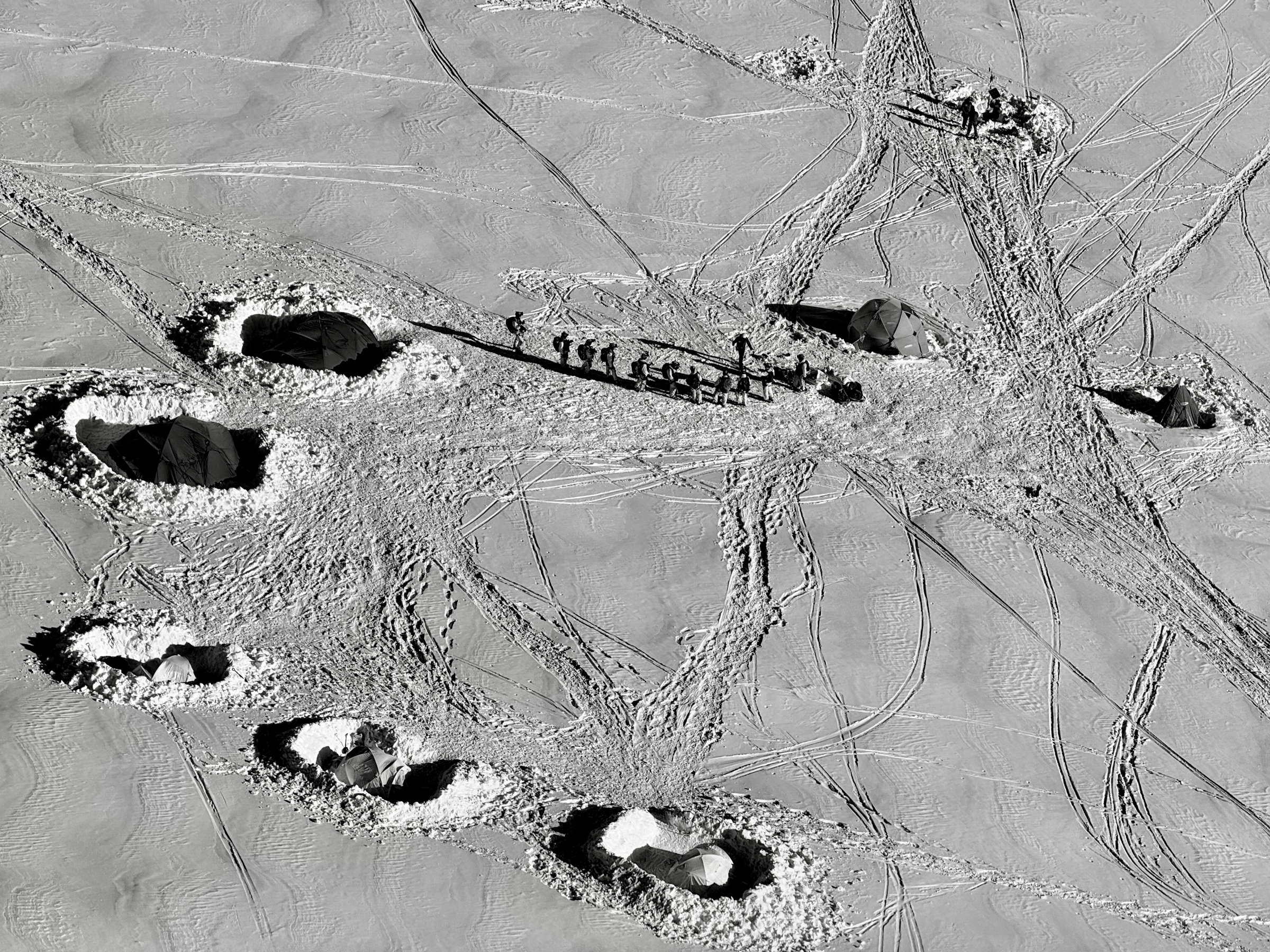
A map of every decision made that morning — the glacier from above
I photograph people looking at things, and the terrace was full of them. A young woman in a white beanie bent to the frost-pitted viewing scope, hands on the cold metal, aiming it at slopes she could have seen perfectly well without it. I understood completely. The scope is not there for seeing better — the view is everywhere, unavoidable. It is there for choosing: one piece of the mountain at a time, held briefly in two cold hands.
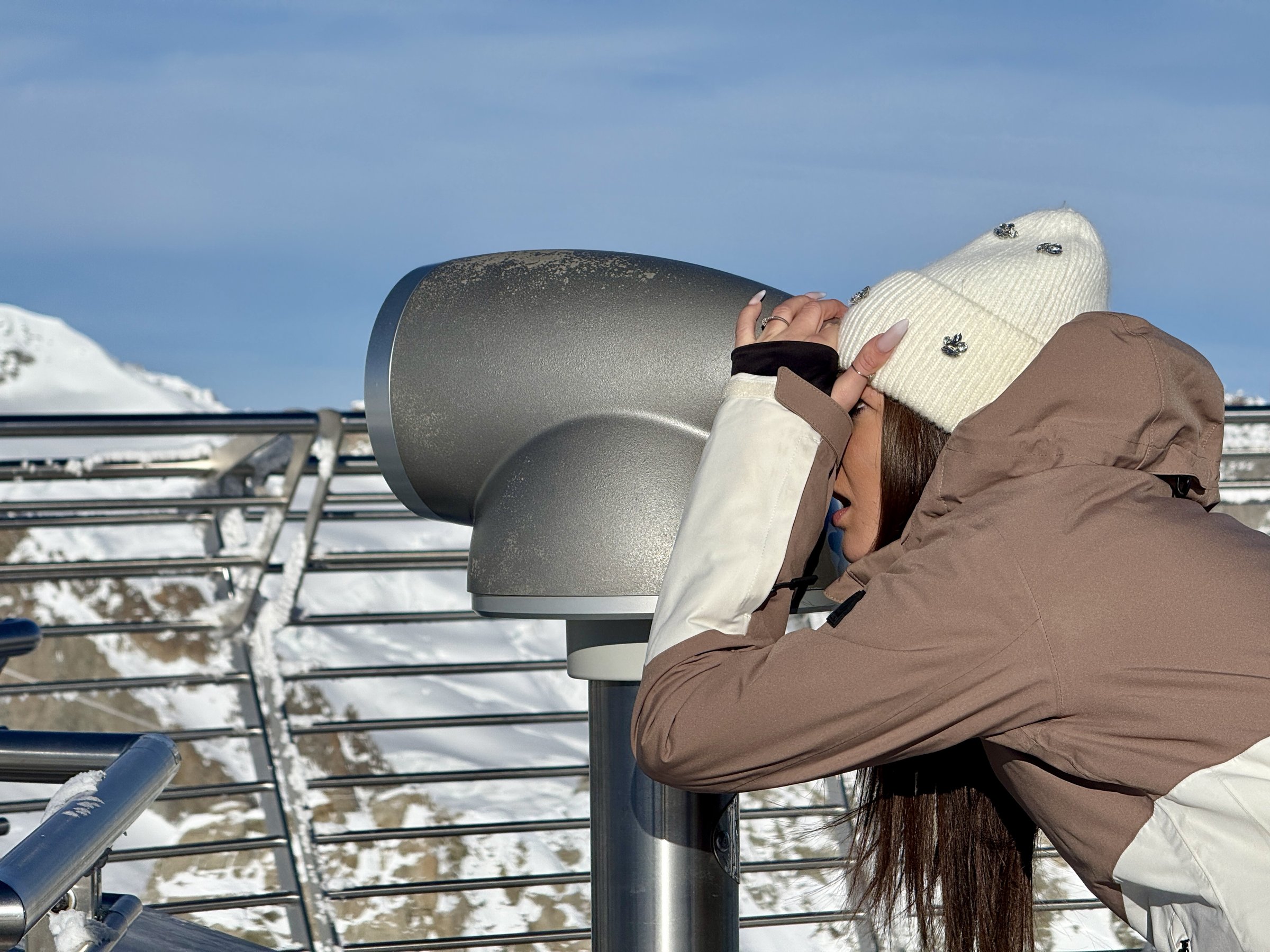
Choosing one piece of the mountain at a time — the terrace
Beside her, wired to the icy railing, the white sign: Punta Helbronner, 3,466 metres. Water droplets on the lettering, a hard shadow across it, the sharp tooth of the skyline behind. The plainest photograph of the set, and the one that anchors all the others.
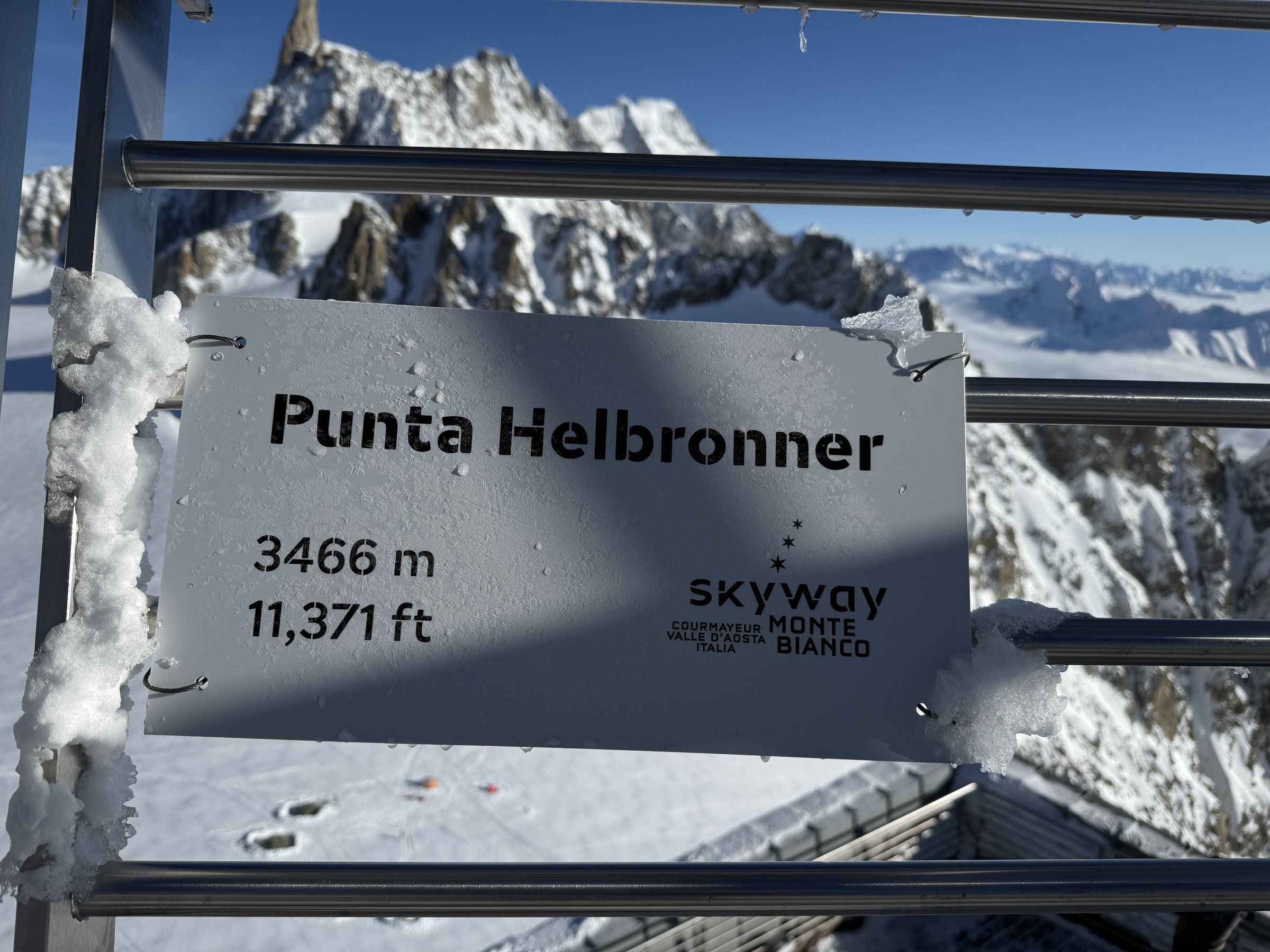
3,466 metres, in writing — Punta Helbronner
Some of what I brought down from that altitude is monochrome — the frames that wanted to be about structure rather than temperature. But the last ones refused. The blue up there is not decoration; it is information — the exact colour of thin air and hard cold — and to strip it out would have been a small dishonesty. So the final photographs stayed in colour, and they carry the same timestamp, 10:54: the cloud sea with ridgelines stacked behind it like waves arrested mid-break, and, closest of all, the great glaciated face itself — tawny granite, hanging seracs, spindrift streaming off the corniced crest, the mountain visibly rearranging its own summit while I watched.
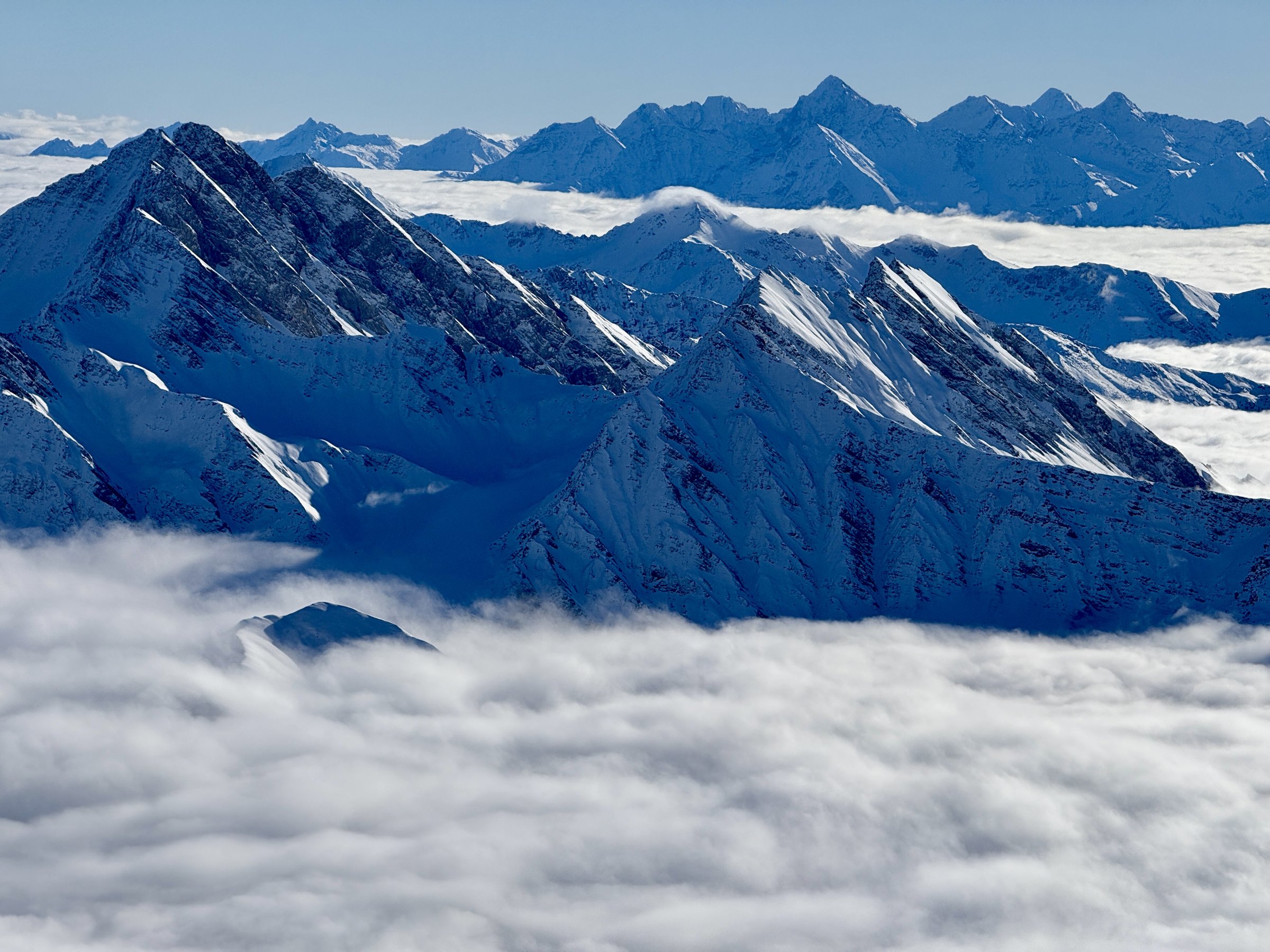
Waves arrested mid-break — from Punta Helbronner

The mountain rearranging its own summit — the Italian face of Mont Blanc
It was rearranging that summit before I raised the camera, and it went on rearranging it after I put the camera down. That, in the end, is the difference between the mountain and the photograph, and the only one that matters: one of them is finished.